|
Since a standards-based approach to compliance can be a daunting undertaking, compliance professionals recognize that a consistent and scalable assessment tool is required to help. Rsam's enterprise-class technology framework allows organizations to :
|
|
 |
|
Establish, enforce and manage a consistent standards based program on individual business criticality and compliance requirements.
|
 |
|
Utilize measurable controls for each standards' domain. Easily create and assign additional assessment questionnaires.
|
|
|
Distribute & gather data via online questionnaires using an intuitive, user-friendly Web interface
|
|
|
Analyze & report on gaps for the entire Enterprise , Business Units, or other logical groups.
|
|
|
Plan, Document and Manage remediation plans after gaps have been identified.
|
|
|
Further demonstrate & validate compliance by assessing a representative sample of Applications, Processes, Infrastructure elements, Data centers, Departments and even Third-party Service Providers.
|
 |
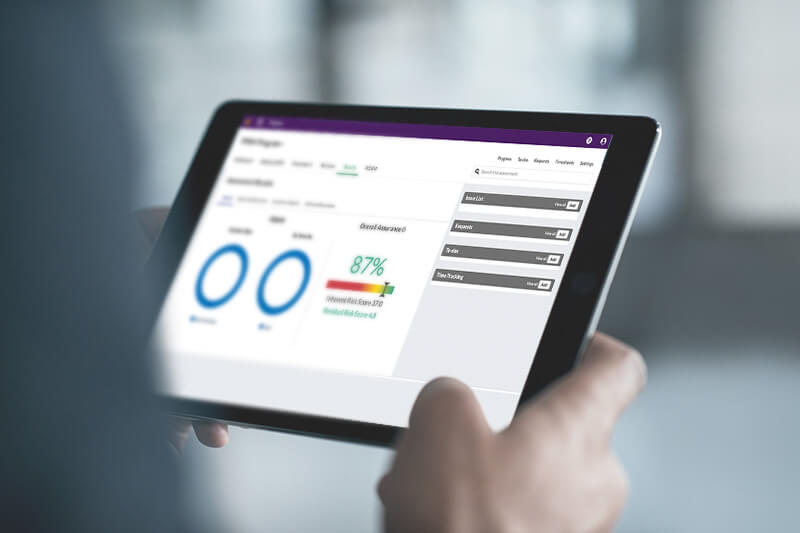
Rsam Compliance Assessments based on standards, takes aspects of this standard and converts them into measurable controls assigned to different logical groups within an organization hierarchy. This logical grouping & organization hierarchy can be used as-is or further customized to meet the specific needs of an organization. Rsam makes your standards-based assessment manageable and enables an analysis to be performed on the assessment data. Rsam works by organizing the assessment into manageable and logical groups. For each grouping Rsam helps gather responses concerning control practices and measures these responses against the expected standards. This information is then processed to identify gaps, and to score them. During this process, users are assigned to answer specific questionnaires concerning the existence and implementation of a control. As users log into the Rsam interface they are presented with simple dashboards showing their assigned tasks and the status of their questionnaires. By clicking on a particular task the user is directed to the appropriate questionnaire page and walked through each assigned question via a highly-intuitive GUI. Upon the completion of a questionnaire, the process can then be passed to other users for review or additional input. All such actions are tracked & logged, and progress reports and administrator dashboards provide constant progress updates. Once gaps and compliance violations are known, the Rsam Remediation Tracking Module can help track & document your remediation plans. Assessment & Risk treatment data can be archived at any time, and using our reporting engine, Historical reports can be generated providing useful trend analysis reports.
Below is an overview of the standards incorporated in Rsam:
|
 |
Successful organizations understand the benefits of information technology (IT) and use this knowledge to drive their shareholders' value. They recognize the critical dependence of many business processes on IT, the need to comply with increasing regulatory compliance demands and the benefits of managing risk effectively. To aid organizations in successfully meeting today's business challenges, the IT Governance Institute® (ITGI) has published a version of COBIT.
COBIT is an IT governance framework and supporting toolset that allows managers to bridge the gap between control requirements, technical issues and business risks. COBIT enables clear policy development and good practice for IT control throughout organizations. COBIT emphasizes regulatory compliance, helps organizations to increase the value attained from IT, enables alignment and simplifies implementation of the COBIT framework.
|
 |
Member agencies of the Federal Financial Institutions Examination Council (FFIEC) implemented section 501(b) of the Gramm-Leach-Bliley Act of 1999 (GLBA) by defining a process-based approach to security in the 'Interagency Guidelines Establishing Information Security Standards' (501(b) guidelines) . The 501(b) guidelines afford the FFIEC agencies (agencies) enforcement options if financial institutions do not establish and maintain adequate information security programs. FFIEC Information Security booklet follows the same process-based approach, and applies it to various aspects of the financial institution's operations and all related data, and serves as a supplement to the agencies' GLBA 501(b) expectations
|
|